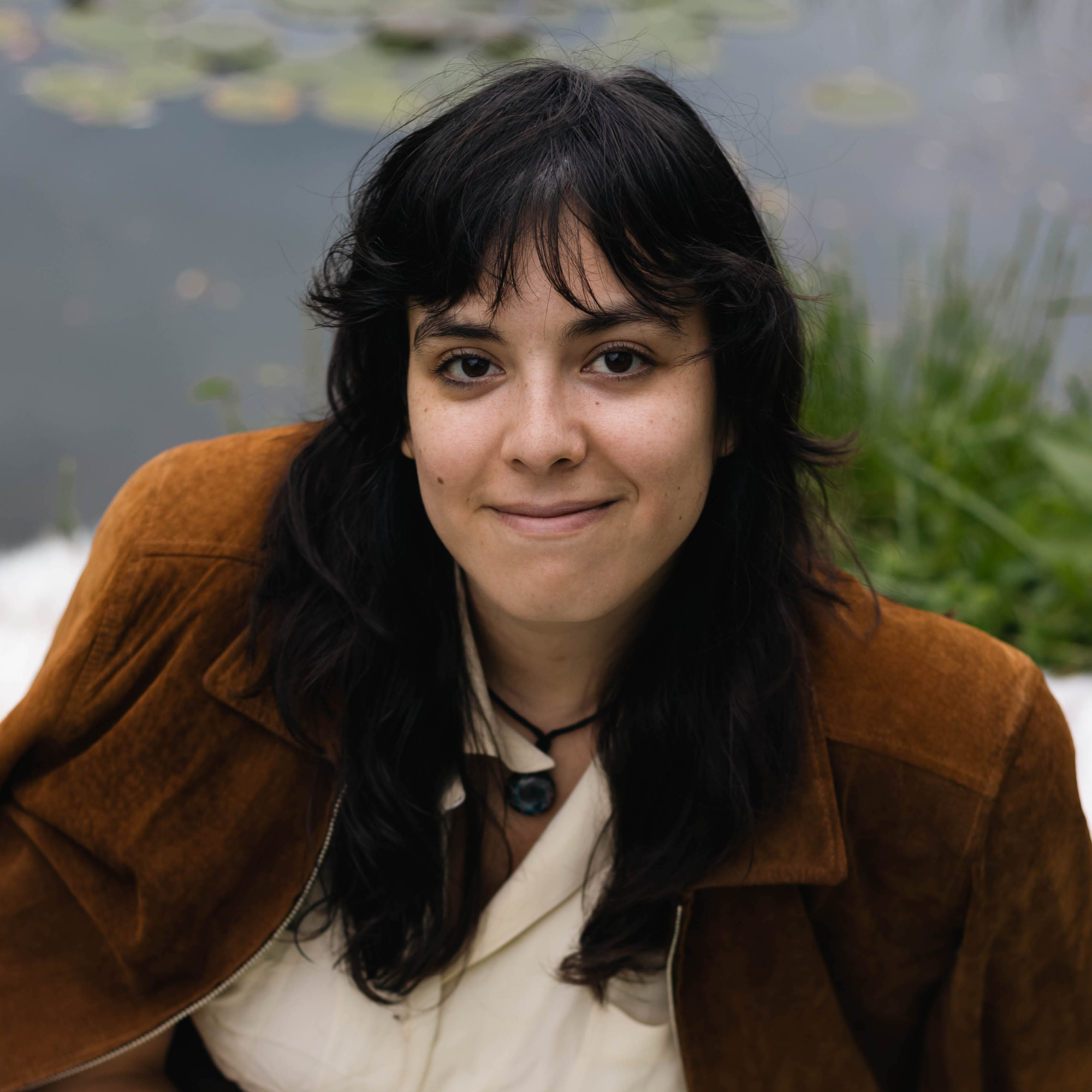
Marina López
Marina López is a Pittsburgh-based composer, educator, and budding writer. She seeks to challenge borders between musical genres and between art forms, to create immersive experiences that challenge the listeners' preconceptions. Born and raised in Mexico City, she has a deep interest in exploring the psychological, ethnomusicological, and physical roots of her musical heritage.
She started pursuing musical composition in the Fall of 2012, under the guidance of the late Dr. David Stock. In the Spring of 2018, she completed her Master's level studies in Musical Composition under Leonardo Balada, at Carnegie Mellon University. Her music has been performed by the Transient Canvas, the Chamber Orchestra of Pittsburgh, the Carnegie Mellon University Contemporary Ensemble, Counter)inductions ensemble, the Carnegie Mellon University Philharmonic, Kamratōn ensemble, and Boston's White Snake Project, amongst others. She has participated in reading sessions with the Pittsburgh Symphony Orchestra under maestro Leonard Slatkin, as well as with the Houston Symphony Orchestra under Maestra Yue Bao.
Her first opera 'Not Our First American' premiered at Pittsburgh Opera on April 13th, 2019, as part of Co-Opera; a year-long collaboration between Pittsburgh Opera and Carnegie Mellon’s Music and Drama departments. Her second opera 'Rosa' premiered in December 2022 by Boston-based opera company Whitesnake Projects. From March to April of 2023, she was awarded a 50th Anniversary Fellowship at the Virginia Center for the Creative Arts, in Amherst, Virginia. She is one of the current Virginia B. Toulmin Orchestral commission grantees, with her piece 'Moño' set to premiere January of 2025 by the Grand Rapids Symphony.
She approaches each piece as its own system, a universe with its own set of rules that govern its unfolding through time. Her goal is always to make these systems intuitively perceptible to the audience. For her piece Nieve (snow), she created a harmonic system based on snowflake crystals that governs not only pitch content but also the harmonic relationships that develop throughout the piece. She is also interested in deconstructing and reconfiguring Western classical musical forms in unexpected ways. In her piece Folia she atomized the Renaissance dance form la folia, resulting in a fractal structure with smaller folias within larger ones.
From the fall of 2020 through the spring of 2021, she developed and led a music education after-school program with local nonprofit Casa San José, which serves the Latino community of the greater Pittsburgh area. She also developed similar curricula for Volta Music Foundation, which seeks to make music education accessible to students in need in Latin America and create music programs that help underserved communities in the US. Ultimately, her goal is to break down the barriers between the Western musical canon and the music of those who have been previously excluded from it.
In the Spring of 2018 Marina’s poem Penance won First Prize at the university-wide Martin Luther King Jr. Writing Award at Carnegie Mellon University. In July of 2020, she published a personal essay in Publicsource, a local Pittsburgh magazine. The essay has since been translated into Spanish and published in Presente Magazine. Marina has been involved with the Mad Women in the Attic writing workshops at Carlow University since the fall of 2019. In the fall of 2021, her poem Para mama Chole was published in their Voices From the Attic biannual publication. In April 2022 her poem 'Deep Cuts' was published as part of the 'Eco-Justice for all!' zine, a special project from poet laureate Celeste Gainey and City of Asylum Pittsburgh. Her poetry was also published in Empyrean Magazine's Second Issue in the Summer of 2022.
Marina expects to continue her writing journey alongside her composition career, sharing and publishing her poetry and fiction both in English and in Spanish.